Officers have always been able to arrest someone encroaching on a crime scene on the charge of resisting an officer without violence, but the new statute extends protections to firefighters, EMS personnel and probation officers and sets the specific 25-foot measurement, according to Ken Padowitz, a former homicide prosecutor and defense attorney based in Fort Lauderdale.

On a humid summer night in Lake Worth Beach, Griffin Ingerson was trying to give a woman and children water when a deputy put him in handcuffs.
He had been walking in his neighborhood when he noticed more than a dozen Florida Highway Patrol and Palm Beach County Sheriff’s Office vehicles camped outside a home, doing what neighbors suspected to be immigration enforcement.
A PBSO deputy repeatedly told Ingerson and the rest of his neighbors to stay back 25 feet from the scene, body-worn camera video shows. But when the deputy walked away briefly, Ingerson moved into the active police scene with a bottle of water.
The deputy tackled Ingerson and arrested him on charges of resisting without violence and interference with first responders under Florida’s new Halo Law. Prosecutors ultimately declined to file formal charges against him.
The 2025 law makes it a misdemeanor for anyone to approach or stay within 25 feet of first responders after a warning with the intent to harass them or interfere with their duties.
Originally proposed as a measure to protect law enforcement from harassment, the Halo Law has taken on a life of its own in the context of a sweeping statewide and national immigration crackdown, advocates say, as South Florida’s legal observers seek to document traffic stops and arrests while other residents — including family members and neighbors — record and protest law enforcement.
Those concerns grew last month, after a man in North Palm Beach was arrested while trying to document Florida Highway Patrol troopers as they detained his cousin, who is now in Alligator Alcatraz.
But even without an arrest, First Amendment advocates say the law has a chilling effect. Frequently, immigration advocates say they are warned to stay 25 feet away when attempting to document enforcement operations. The law already could be preventing people from documenting immigration stops, they say, some of which could be illegal.
“This marriage (of the Halo Law and immigration enforcement) is really, really a recipe for disaster and can culminate in the violation of our rights,” Renata Bozzetto, a deputy director of the Florida Immigration Coalition, told the South Florida Sun Sentinel. “And most important and absolutely most troublesome is it can culminate into people being detained and taken from our communities without adequate oversight and without accountability.”
Local law enforcement and state government officials say the law is necessary to protect first responders from harassment and injury while they do their jobs, adding that it doesn’t prevent people from observing or recording law enforcement; it simply mandates that they stay 25 feet away, or about one-and-a-half car lengths.
In dozens of arrests made over the past year under the statute in Broward and Palm Beach counties reviewed by the Sun Sentinel, most involved people threatening, harassing, yelling at or distracting officers while they performed routine traffic stops, managed crash scenes or large crowds, responded to domestic disturbances and medical calls, or investigated drug-related crimes, court records show. In some cases, officers wrote in arrest reports that they were pushed or hit.
Many of the court cases are ongoing, records show, with several ending in plea agreements, while prosecutors also opted not to file charges in other cases. Only a few arrests in the cases reviewed by the Sun Sentinel were explicitly related to immigration enforcement.
Still, advocates fear that the law could hamper oversight or protesting of the state’s immigration crackdown. Some proponents are seeking to apply it to immigration enforcement directly. In November, U.S. Sen. Ashley Moody, R-Fla., proposed a federal version of the law in response to “reports of violence and harassment against federal officers,” which she has touted again recently in response to the protests against federal agents taking place in Minneapolis that have ended in two fatal shootings of civilians.
“Our federal officers are facing assaults and violence at record levels, that simply cannot stand,” Moody said in a January news release. “It is our responsibility to ensure these officers have the ability to safely carry out their important duties free of impediment and harassment.”
Origins of the law
The bill that became the Halo Law originally had little to do with immigration. It was introduced in 2023, when Joe Biden was still president, by Miami-Dade Republicans Sen. Bryan Avila and Rep. Alex Rizo, who had sponsored some version of the bill for three sessions before it passed, starting in 2021.
At the time, state legislators and law enforcement officials said they were growing concerned about citizens who sought to record police officers for content, including groups known as First Amendment auditors.
Al Palacio, second vice president of the Florida Fraternal Order of Police, told the Sun Sentinel that he helped formulate the idea for the bill with Rizo at a time when officers were frequently dealing with “auditors” coming up “in your face within an inch” to record them and ask for names and badge numbers.
At the time, proponents of the bill mentioned that it could also be used to crack down on Spring Breakers. Critics, meanwhile, brought up police brutality, citing the killing of George Floyd, the video of which spurred national outrage.
No reports from the time of the bill’s passage mentioned immigration.
Regardless of context, Palacio told the Sun Sentinel that the law is appropriate for law enforcement to use, though he added, “if you’re abusing the law, we don’t tolerate that either.”
“Whether you’re using it for traffic enforcement, or whether you’re using it because of a demonstration, or whether you’re using it during an event involving immigration, doesn’t change the fact that this is the law,” he said.
Rizo declined to comment through his aide, saying he was too busy for an interview.
Officers have always been able to arrest someone encroaching on a crime scene on the charge of resisting an officer without violence, but the new statute extends protections to firefighters, EMS personnel and probation officers and sets the specific 25-foot measurement, according to Ken Padowitz, a former homicide prosecutor and defense attorney based in Fort Lauderdale.
Now, with nearly all of Florida’s law enforcement agencies participating in 287(g) agreements with ICE and a growing number of people protesting or recording law enforcement when they conduct immigration-related stops, the law has taken on new local and national significance.
“Because of the growing sentiment and willingness of citizens to express themselves legally on the street over ICE operations, it’s very easy to imagine that that would be the event in which this law would be used,” said Bobby Block, the executive director of the Florida First Amendment Foundation.
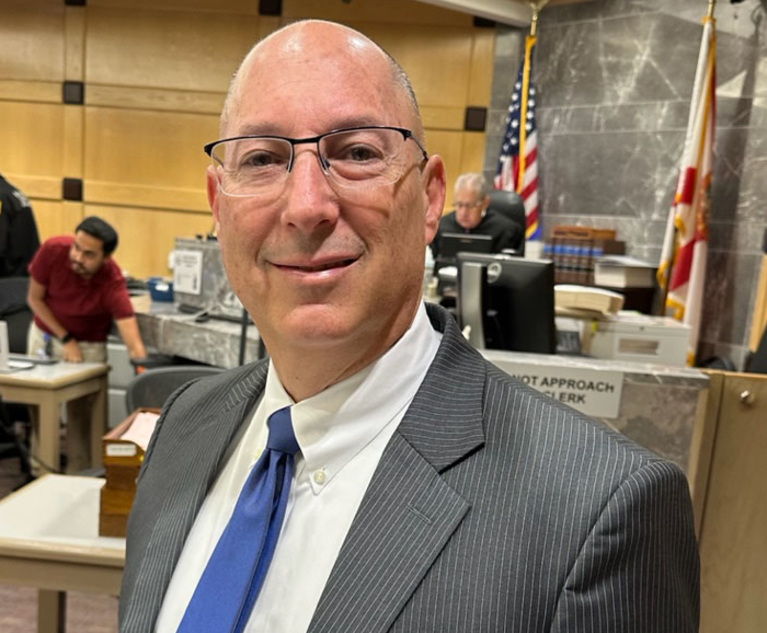
Criminal Defense Trial Lawyer Ken Padowitz
Confrontations and arrests
Already, a number of confrontations between residents and law enforcement have taken place in South Florida since the immigration crackdown became more visible, with officers invoking the 25-foot rule.
In North Palm Beach last month, Melbi Morales told reporters he witnessed his cousin, Jose Luis Perez Bravo, be detained on an immigration hold while he ended up in jail himself for violating the Halo Law.
An FHP trooper had pulled Bravo over and handcuffed him, according to a video that has since gone viral. Morales, standing outside of the car, asked the trooper what he was doing and why his cousin was being arrested, according to the footage. The trooper warned Morales he would be arrested if he didn’t move back 25 feet. He also warned the woman recording the video.
“If you don’t get back 25 feet, ma’am, you’re going to jail with him,” the trooper said to the woman as she walked by Bravo’s car. “So keep walking. The only warning you’re getting.”
As the trooper arresting Bravo prepared to walk him away, a second trooper shouted at Morales to move back 25 feet or face arrest. He shouted multiple times for Morales to move back, then lunged at Morales seconds later, the video shows, at one point wrapping his forearm behind Morales’ neck.
As the skirmish continued, the trooper pulled out his Taser and threatened to shock Morales, though the trooper wrote in a probable cause affidavit that Morales was not struck by the probes. The video then showed troopers arresting Morales.
Morales declined to comment when reached by the Sun Sentinel, though he confirmed that his cousin is currently being held at Alligator Alcatraz. In an interview with WPEC-CBS12, he said he had never heard of the Halo Law.
Immigration advocates cited the altercation as a recent example of law enforcement overreach under the law.
The question it raises, Bozzetto said, “is what happens when officers abuse the power Halo Law gives them, in order to intimidate or retaliate against a legal observer?”
The Florida Highway Patrol did not respond to a request for comment.
Multiple confrontations have also taken place in Lake Worth Beach, which has become a focal point of immigration enforcement in recent months as FHP troopers patrol neighborhoods and where more than 100 PBSO deputies are trained to act as immigration officers under the agency’s 287(g) agreement.
In one incident last year, former Lake Worth Beach Commissioner Cara Jennings recorded FHP troopers arresting a man who troopers said had no license and whose truck was unregistered, according to video a Lake Worth Beach resident shared with the Sun Sentinel.
She asked the man for his name and phone number as he was handcuffed and about to be placed into a trooper’s car, so that she could connect his family with him, the video showed.
As Jennings questioned the troopers, one told her the man would be turned over to Border Patrol custody. Another warned her to stay back.
“25 feet, Governor DeSantis has said you are too close to me, step away,” the trooper said as Jennings continued to question him. “… Keep stepping, ‘cause the back of my patrol car is too close. Twenty-five feet back from my patrol car.”
Jennings did not respond to a voicemail and message seeking comment.
The night of Ingerson’s arrest in August, PBSO deputies were assisting FHP troopers during an operation along C Street in Lake Worth Beach. The affidavit for Ingerson’s arrest did not include details about whether the scene was related to immigration enforcement.
Ingerson told the Sun Sentinel officers repeatedly called a Hispanic name on a bullhorn for more than an hour and banged on the door of a home with a battering ram while a crowd congregated around the scene.
At one point, Ingerson told the Sun Sentinel, officers had detained two men, a woman and at least two young children. The woman and children, who were not handcuffed, were being detained on a curb over the hour that neighbors watched.
The deputy who later arrested Ingerson remained in front of his patrol car as he managed the crowd gathered at the scene.
“If you stand over there, you gotta tell them to move back 25 feet from you, and if they don’t, then we can hook ’em up,” another law enforcement officer told him, according to body-worn camera video.
“Yeah but, there’s also, like, six of them and they’ve been staying there, so … As long as they’re there,” the deputy responded.
Over the next 25 minutes, the deputy repeatedly warned Ingerson and other neighbors to stay behind his patrol car while he stood in front of it. Toward the end of the 30 minutes of footage, the deputy said over radio that the crowd of 30 or 40 people was “starting to get a little antsy” after he was asked over and over by Ingerson and others if the woman and children could have the water Ingerson had brought for them.
Less than 30 seconds later, Ingerson approached the woman and children on the sidewalk while the deputy, with his back turned, took several steps into the street, away from the curb and the patrol car. When the deputy turned around and saw Ingerson, he tackled Ingerson and handcuffed him as multiple witnesses continued to record and shout insults or curse at the deputy.
While Ingerson sat handcuffed on the ground, the deputy told him, “I gave you three times to stay behind the car, sir,” the video showed.
As witnesses continued to heckle the deputy and were told to get 25 feet back, one asked, “Can we get a measurement?” a cellphone video of the arrest shared with the Sun Sentinel showed.
The Palm Beach County State Attorney’s Office opted not to pursue charges against Ingerson.
In response to the Sun Sentinel’s request for an interview for this article, a Palm Beach County Sheriff’s Office spokesperson said the district’s captain was unavailable to comment on Ingerson’s case.
‘Confusing’
Some legal experts and defense attorneys say aspects of the law are vague and could lead to improper arrests and unsuccessful prosecutions in Florida courts.
“It’s a statute with two sub-sections,” said Matthew Konecky, a Palm Beach County defense attorney. “And every part of it is confusing.”
The statute, F.S. 843.31, states that “it is unlawful for a person, after receiving a verbal warning not to approach from a person he or she knows or reasonably should know is a first responder, who is engaged in the lawful performance of a legal duty, to knowingly and willfully violate such warning and approach or remain within 25 feet of the first responder with the intent to: 1. Impede or interfere with the first responder’s ability to perform such duty; 2. Threaten the first responder with physical harm; or 3. Harass the first responder.”
It defines “harass” as “to willfully engage in a course of conduct directed at a first responder which intentionally causes substantial emotional distress in that first responder and serves no legitimate purpose.”
But the statute does not define emotional distress.
“If a first responder feels they’re being harassed because a family member is emotionally charged and is screaming, someone is being illegally arrested, or has a medical condition and someone sees it and is screaming at the person, ‘help him, help him,’ a first responder shouldn’t suffer emotional distress for just being yelled at, that’s part of their job,” Konecky said. “You could see where this could cause more problems than this is designed to help.”
Padowitz, the former prosecutor, said the language pertaining to emotional distress would be “very difficult for the government to prove” and potentially “even unenforceable.”
Delineating 25 feet is also difficult; Padowitz questioned how the government may prove beyond a reasonable doubt that someone was too close.
Those arrested may succeed in court after arguing that they were not impeding or interfering or harassing an officer, “but you have to test it in court after an arrest,” he said.
“I would recommend to avoid arrest, just get back the 25 feet after warning, and then you can still observe or videotape the actions of the officer and you’re not interfering with their work or violating the law,” he said.
Palacio, of the state FOP, said emotional distress, in his opinion, means “you’re making the situation worse by your presence being there.”
“If you’re there while somebody is getting arrested, you’re not helping the situation, then you really need to take a step back and see how you can,” he said. “We’re not telling you not to film. We’re telling you everything you do, please do it from 25 feet away.”
Legal observers
Advocates throughout Florida and the rest of the country have started operating as “legal observers,” following law enforcement officers and recording or documenting the state’s immigration crackdown. Their goal is to watch for abuses of power or unlawful stops and create a database with information about who is being detained. Observers also collect names with the goal of connecting those detained with family members.
Some advocates say the Halo Law should not change how they go about their work. Legal observers are trained to observe, said Bozzetto, not to harass or interfere with law enforcement.
“The reality of legal observing is that the Halo Law doesn’t change it,” Bozzetto said. “Because the premise for the Halo Law is, if you are interfering with law enforcement, you have to move away. But the person who is observing is absolutely not interfering.”
Still, lawyers and law enforcement experts are recommending that observers stay 25 feet away.
“Unless you are looking to make case law and you don’t mind spending a weekend in jail or something like that, I’d probably follow the instructions to stay away,” said Block, of the Florida First Amendment Foundation.
Advocacy groups are already training their observers to keep a distance.
“In our training it’s very much emphasized to stay 25 feet away,” said Jennifer Jones, an organizer with Hope and Action Indivisible. “Because our goal is really to keep everyone safe, including ourselves.”
Recording is a First Amendment right, said Block, who thinks Florida’s law could be deemed unconstitutional if it’s challenged in court. In Arizona, a federal judge blocked a more stringent version of Florida’s bill, which made it a crime to record law enforcement within 8 feet.
Within the state, some of the law’s proponents feel that the distance should not substantially infringe on people’s right to record.
“Twenty-five feet — you can still observe everything perfectly,” said Carl Hannold Jr., a retired Fort Lauderdale police officer, adding that the range doesn’t necessarily put officers out of harm’s way, either.
Others argue that the 25-foot distance can make it more difficult to obtain law enforcement’s badge numbers and IDs, as well as simply observe what they are doing.
Bozzetto brought up the recent killing of Alex Pretti in Minnesota as an example.
“Just see what happened in Minnesota, that disaster in Minnesota,” she said. “You can see how much of a public opinion on the truth we were able to gather through different angles and proximity. The truth can be very easily twisted with distance and that’s scary.”