


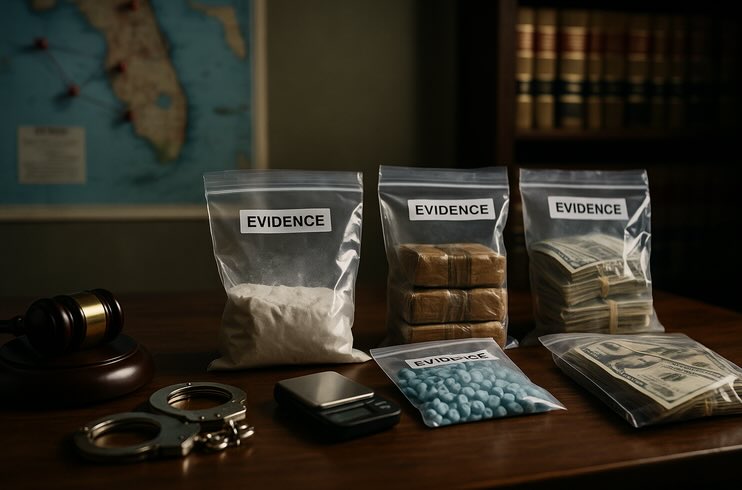
Florida Drug Trafficking Laws and Federal Drug Trafficking Charges
Introduction – What is Drug Trafficking?
Drug trafficking charges in Florida are among the most serious drug offenses, prosecuted aggressively under both state and federal law. In Florida, drug trafficking is defined by statute based on the weight or quantity of controlled substances involved, and even mere possession of a large amount of drugs can lead to trafficking charges with harsh mandatory minimum prison terms. At the federal level, drug trafficking is typically charged as the crimes of distributing, manufacturing, or possessing with intent to distribute controlled substances under laws like 21 U.S.C. § 841, and conspiracies under 21 U.S.C. § 846. This article provides an overview of Florida’s drug trafficking laws (with an emphasis on Florida Statutes § 893.135) and relevant federal laws, explains how trafficking is defined, lists common substances involved, outlines the penalties and sentencing guidelines (including Florida’s mandatory minimums and federal sentencing issues), describes typical investigative agencies and methods, and discusses possible legal defenses.
Drug Trafficking Under Florida Law (Definitions and Statute)
Florida law defines “drug trafficking” in Florida Statutes § 893.135 as knowingly selling, purchasing, manufacturing, delivering, bringing into Florida, or possessing a threshold quantity of certain controlled substances. Unlike the common image of international drug smuggling, under Florida law a person can be charged with trafficking solely for possessing a large amount of drugs, even if there is no evidence of actual sale. The threshold quantities are specified by drug type – if you have above a certain weight or number of units of a drug, Florida law presumes you are trafficking. For example, possessing over 25 pounds of cannabis or 300 cannabis plants is trafficking in cannabis, and possessing 28 grams or more of cocaine (about one ounce) is trafficking in cocaine. Notably, only 4 grams of heroin or other opiates can qualify as trafficking in illegal drugs. These threshold amounts are relatively low, meaning even small quantities of potent drugs (especially opioids) can trigger trafficking charges.
First-Degree Felony: Trafficking in any controlled substance is at least a first-degree felony in Florida. This is one of the most serious felony levels, typically punishable by up to 30 years in prison (and in some cases even more, as explained below). However, Florida’s trafficking law goes further – it imposes mandatory minimum prison sentences and heavy fines that depend on the amount of drugs involved. These penalties are severe and fixed by statute, meaning that if convicted as charged (with trafficking), the judge generally must impose at least the minimum term (unless certain rare exceptions for cooperation – “substantial assistance” – apply). We outline the penalty structure in a later section, but as an example, trafficking between 28 and 200 grams of cocaine carries a 3-year mandatory minimum prison term and $50,000 fine, while 400+ grams of cocaine carries 15 years minimum and $250,000 fine. The law similarly sets tiered mandatory sentences for other drugs based on weight. Florida also labels special cases like extremely large quantities or drug-related deaths as capital felonies (potential life sentence or even capital punishment), though those are less-common scenarios.
Key Florida Statute (Fla. Stat. § 893.135): This statute enumerates trafficking offenses for various substances. Some of the most relevant provisions include:
- Cannabis: Possession/transport of over 25 lbs (or 300 plants) is “trafficking in cannabis.” Mandatory minimum sentences range from 3 years (25–2,000 lbs) to 15 years (over 10,000 lbs), with fines from $25,000 up to $200,000
- Cocaine: 28 grams or more is “trafficking in cocaine.” Penalties escalate by weight: 3-year min for 28–<200g, 7-year min for 200–<400g, 15-year min for 400g–<150 kg, and life in prison if 150+ kg.
- Heroin & Other Opiates: 4 grams or more of heroin, morphine, oxycodone, hydrocodone, or related opioid substances is “trafficking in illegal drugs.” The tiers are 4–<14g: 3-year min, 14–<28g: 15-year min, and 28g–<30kg: 25-year min, plus fines up to $500,000. If 30 kg or more are involved, it’s an automatic life felony.
- Fentanyl and Analogues: Florida has recently enhanced penalties for fentanyl. Trafficking in 4 grams or more of fentanyl or its analogs is a first-degree felony termed “trafficking in dangerous fentanyl,” with 7 years minimum for 4–<14g, 20 years for 14–<28g, and 25 years for 28g or more. Example: Just a few thousand counterfeit pills laced with fentanyl can easily exceed 4 grams. Florida even added a 25-years-to-life penalty if an adult sells at least 4g of fentanyl to a minor and the fentanyl was disguised to look like candy or a legitimate product (a response to still-continuing alarming incidents of fentanyl pills colored and marketed in child-attractive forms).
- Methamphetamine/Amphetamines: 14 grams or more of meth or amphetamine is trafficking. The statute sets 3-year min for 14–<28g, 7-year min for 28–<200g, and 15-year min for 200g or more.
- Prescription Opioids: High quantities of prescription painkillers (e.g. oxycodone, hydrocodone) fall under the same “trafficking in illegal drugs” statute as heroin. This means someone trafficking prescription pills (outside of legal pharmacy channels) faces the 4 gram threshold and same 3/15/25-year minimum tiers noted for heroin. Florida’s history with “pill mills” and opioid distribution has led to aggressive prosecution of pill trafficking rings.
Conspiracy: Importantly, Florida law also criminalizes conspiracy to engage in trafficking under the same statute. If you agree or plan with others to commit trafficking, you can be charged with a second-degree felony (one level below the completed trafficking offense) for the conspiracy. This means even planning (or in any way, taking a substantive role in) a large drug deal or coordinating a supply chain, without actually handling the drugs, can result in serious charges.
Mandatory Minimums and Exceptions: The mandatory minimum sentences in Florida’s trafficking laws mean that, upon conviction, the judge must impose at least the minimum term (e.g. 3, 7, 15, 25 years, depending on the charge) and cannot depart below it. These are calendar years that must be served day-for-day (no early release on these minimum terms). Florida’s Criminal Punishment Code also assigns very high offense severity levels to trafficking crimes (often Level 7, 8, or 9 out of 10), which usually guarantees a substantial guideline sentence even if the mandatory minimum didn’t exist. But since the minimums do exist, they effectively override the guidelines when they call for more time. However, Florida law does allow one major exception: if the defendant provides “substantial assistance” to law enforcement in identifying or convicting accomplices or other traffickers, the prosecutor can move to reduce or suspend the mandatory sentence. In practice, this means cooperating with authorities (becoming an informant or helping in other investigations) might lead to a lesser sentence, but that decision lies largely with the State Attorney’s office to take the threshold action and file the motion (and then, for the sentencing court to agree with the request and exercise its discretion to sentence lower than required by statute). Apart from that scenario, alternatives like probation or withholding adjudication are generally not available in trafficking cases that don’t get reduced/down-filed, and prison time is the norm if convicted.
Federal Drug Trafficking Laws
Federal Offenses vs. Florida: Drug trafficking is also a federal crime, prosecuted in U.S. federal courts, especially for large-scale operations, interstate or international cases, or when federal agencies (DEA, FBI, Homeland Security) drive the investigation. Unlike Florida’s law that defines trafficking by specific weight thresholds, federal law does not require a minimum amount of drugs to charge you with a trafficking crime. Under 21 U.S.C. § 841(a), it is illegal to manufacture, distribute, or possess with intent to distribute any controlled substance, regardless of quantity (quantity does influence potential penalties, however). Even relatively small amounts can lead to federal charges if other factors (like crossing state lines or involvement of a federal task force) are present. In federal cases, the term “drug trafficking” is a broad concept encompassing offenses like drug distribution, drug importation, and possession with intent to distribute. Additionally, 21 U.S.C. § 846 makes it a crime to conspire or attempt to commit any drug trafficking offense – conspiracy charges are very common in federal drug cases and carry nearly the same (sometimes, essentially identical) penalties as the completed offense. This means that being part of a drug trafficking organization or network, even if you played a minor role, can result in charges that are just as serious as those faced by the main distributor.
Common Federal Trafficking Charges: Federal prosecutors often use a few key statutes for drug traffickers:
-
21 U.S.C. § 841 – for possession with intent to distribute, distribution, cultivation or manufacture of controlled substances (covers essentially all unlawful dealing of drugs).
-
21 U.S.C. § 846 – for conspiracy to commit any of the above (used to indict multiple co-conspirators in a drug ring under one case).
-
21 U.S.C. § 960 – for drug importation and exportation offenses (if the case involves smuggling across U.S. borders).
-
21 U.S.C. § 843(b) – using communication facilities (like telephones) to facilitate drug trafficking (often added for folks arranging deals by phone).
-
21 U.S.C. § 848 – Continuing Criminal Enterprise (the “drug kingpin” statute) which targets organizers of large, ongoing drug operations and carries extremely heavy penalties (20 years to life minimums)
For most defendants, §841 and §846 are the core of federal trafficking prosecutions.
Federal Penalties and Sentencing: Federal drug trafficking penalties are generally driven by the type and quantity of drugs involved, similar in spirit to Florida’s weight thresholds, but structured differently. Federal law sets mandatory minimum sentences at certain quantity levels, specified in 21 U.S.C. § 841(b). The two primary tiers are:
- Five-year mandatory minimum (up to 40 years max): Triggered by quantities such as 100 grams of heroin, 500 grams of powder cocaine, 28 grams of crack cocaine, 40 grams of fentanyl, 5 grams of pure methamphetamine (or 50 grams of a meth mixture), or 100 kilograms of marijuana (or 100 plants). For example, distributing just over 3½ ounces of heroin or a couple of ounces of fentanyl can mandate a 5-year federal prison term at minimum.
- Ten-year mandatory minimum (up to life): Triggered by larger quantities such as 1 kilogram of heroin, 5 kilograms of cocaine, 280 grams of crack, 400 grams of fentanyl, 50 grams of pure meth (or 500 g mixture), or 1,000 kg of marijuana (or 1,000 plants). For instance, a conspiracy dealing in multi-kilo shipments (approximately 2.2 lbs of heroin or 11 lbs of cocaine) will face at least a 10-year mandatory sentence under federal law.
Federal sentences can be even higher if certain aggravating factors apply. If a person has prior felony drug convictions, the mandatory minimums jump (one prior can double the minimums; two or more priors can lead to mandatory life in prison under 21 U.S.C. § 841(b)). If death or serious bodily injury resulted from the distributed drugs (for example, a customer overdosed and died), there is a 20-year mandatory minimum penalty. There are also specific enhancements for trafficking offenses that involve distributing to minors or within protected zones (like near schools or playgrounds), which carry additional penalties – e.g., 21 U.S.C. § 859 and § 860 impose higher sentences for those situations.
Aside from mandatory minimums, the Federal Sentencing Guidelines also play a major role in determining the actual sentence. The Guidelines assign each case a score (offense level) largely based on drug quantity (and purity, for some drugs) and the defendant’s role. Although advisory, federal judges consider the Guidelines range when imposing sentence. In practice, many federal trafficking sentences exceed the minimum, especially for large conspiracies or higher-level actors. Unlike Florida’s fixed statutory fines, federal fines are often in the millions for large drug cases, though the main focus/concern is usually on prison time.
No Parole in Federal Prison: It’s important to note that in the federal system there is no parole. A person sentenced to, say, 10 years must serve at least about 85% of that time (with modest credit for good behavior). This is similar with Florida’s current state system (no parole), where certain inmates (not for trafficking minimums, but in general) can earn gain-time.
Safety Valve Relief: There is a provision in federal law (18 U.S.C. § 3553(f), known as the “safety valve”) that allows certain first-time, non-violent offenders who meet strict criteria to be sentenced below the mandatory minimum. If eligible (no significant criminal record, no violence or guns, not a leader of the operation, and you cooperated truthfully with the government), the court can ignore the mandatory minimum and sentence according to the Guidelines, which can sometimes result in less time. This is a key difference from Florida law, which has no equivalent of a safety valve (aside from the cooperation-based departure, or an agreed-to change-of-charge to a crime without the mandatory minimum).
Federal vs. State Prosecution: Many drug trafficking cases could potentially be prosecuted in either state or federal court. Whether a case goes federal often depends on the investigating agency and scope of the operation. For example, a local bust by city police of an individual with a few ounces of cocaine will typically stay in Florida state court. But a months-long investigation by a DEA task force involving multiple counties or states, wiretaps, and large seizures is likely to go to federal court. Florida’s law enforcement agencies often collaborate with federal agencies through joint task forces (e.g. HIDTA – High Intensity Drug Trafficking Area task forces), and sometimes a case that starts with a state arrest gets “adopted” by federal prosecutors if it connects to a larger network. Federal court generally means higher stakes: the sentences can be longer, the system is more rigid (essentially, defendants have less protections and “rights”), and the resources of the U.S. government are formidable. An experienced criminal defense attorney will know the nuances of both systems and, when possible, can strive to argue to keep a case in the more lenient forum or negotiate charges to avoid the most draconian penalties. In any event, both Florida and federal systems severely punish drug trafficking, and the overlapping jurisdiction means a person might be subject to either or both (there is no Double Jeopardy issue if one were to be charged in both State and Federal court, simultaneously, for the same conduct). It’s critical to have legal counsel who understands the nuances of each system’s penalties to advise on the best course.
Common Drugs in Trafficking Cases (Florida Trends and Most Trafficked Substances)
Drug trafficking in Florida involves a variety of controlled substances, but some appear in prosecutions far more often than others. Below are the most commonly trafficked substances in recent years, based on apparent trends in law enforcement activity and prosecutions:
- Fentanyl and Fentanyl Analogs: Fentanyl (a synthetic opioid) has become the number one threat in drug cases due to its extreme potency and deadly impact. In Florida, fentanyl trafficking cases have surged as the opioid epidemic shifted from prescription pills and heroin to fentanyl. Only 4 grams of fentanyl (a few dozen pills or a small amount of powder) triggers a trafficking charge in Florida, reflecting lawmakers’ concern with its lethality. Federally, fentanyl is likewise treated harshly: 40 grams can trigger a 5-year minimum, and 400 grams a 10-year minimum. Recent data show that fentanyl has largely supplanted heroin as the opioid of choice on the streets, and it is now involved in the majority of opioid overdose deaths. Florida has responded with enhanced penalties (as noted, up to 25 years minimum for as little as 28g of fentanyl, and special provisions for targeting those who market fentanyl to children). Traffickers often mix fentanyl into other drugs (like counterfeit oxycodone pills or even cocaine), exacerbating the danger. Both state and federal authorities have made fentanyl cases a top priority.
- Heroin and Other Opioids: Heroin used to dominate opioid trafficking but has been overshadowed by fentanyl in recent years. Still, heroin trafficking is prosecuted frequently. Florida’s threshold of 4 grams for heroin or related opioids means even a small bundle of heroin can lead to a trafficking charge. In South Florida’s past, there were significant operations importing high-purity Colombian heroin, and law enforcement remains vigilant. In addition to heroin, illegal distribution of prescription opioids (like oxycodone, hydrocodone, morphine pills) is also common. Large-volume pill trafficking rings – for example, obtaining thousands of oxycodone pills to sell on the black market – are charged under the same trafficking statute. After Florida’s crackdown on “pill mills” about a decade ago, the supply of prescription opioids became more restricted, which unfortunately contributed to many users switching to heroin or fentanyl. Nonetheless, prosecutions still occur for doctors, pharmacists, or organized crews diverting pills. The most famous example was Operation Oxy Alley years ago, where federal and state authorities busted a massive oxycodone trafficking network in Florida. Bottom line: Opioids (whether heroin or prescriptions) remain a key focus for trafficking enforcement due to the high risk of addiction and overdose.
- Cocaine: Cocaine trafficking has a long history in Florida – since the “Miami Vice” days – and it continues to be one of the most commonly trafficked drugs. Florida’s geography and ports make it a natural transshipment point for cocaine coming from South America. Trafficking in cocaine is charged starting at 28 grams (roughly an ounce) in Florida, but cases often involve much larger amounts (kilograms). We still see numerous state-level cases involving a few ounces to a few kilos of cocaine, often handled by specialized narcotics units. Federally, cocaine is a staple of drug prosecutions as well: 5 kilograms of cocaine (about 11 pounds) triggers a 10-year federal minimum sentence. In the last few years, the purity and sources of cocaine have remained fairly consistent, though there’s concern about fentanyl being mixed into cocaine by suppliers (causing fatal overdoses in users who didn’t expect opioids). South Florida in particular (e.g., Miami, Fort Lauderdale, West Palm) still sees large cocaine trafficking schemes, sometimes tied to Caribbean or Latin American networks. Law enforcement task forces (such as the DEA’s Miami Field Division) frequently conduct undercover stings and multi-agency operations to dismantle cocaine distribution rings.
- Methamphetamine: Meth trafficking in Florida has risen substantially in recent years. Methamphetamine, a powerful stimulant, was once produced in large numbers of small “labs” in rural or suburban areas. Now, however, almost all meth in the United States and Florida is manufactured in Mexico and/or supplied by Mexican drug cartels, who manufacture it in large quantities and smuggle it into Florida and other states. Florida law sets the trafficking threshold at 14 grams for meth, which can be just a few tablespoonfuls of crystal meth. Many state trafficking cases involve a few ounces up to a pound of meth, often seized during traffic stops or parcel shipments. On the federal side, meth cases are punished very severely – only 50 grams of a meth mixture (or 5 grams of pure meth) triggers a 5-year federal minimum. , and larger quantities common in cartel distribution (500+ grams) carry 10-year minimums. Recent trend reports indicate meth use and availability in Florida are “high to very high,” often co-occurring with fentanyl in the drug supply (although deaths caused due to the drug(s) appear to have decreased recently). Meth trafficking investigations often involve lengthy surveillance and informants, as couriers transport meth from border states or distribution hubs like Atlanta into Florida. The DEA and local agencies frequently conduct controlled buys to penetrate meth networks.
- Marijuana: Marijuana (Cannabis) remains a frequently trafficked substance, notwithstanding shifts in legal status. Florida has legalized marijuana only for medical use with strict regulations, and recreational possession/sale is still illegal. Trafficking in cannabis is defined as possession of more than 25 pounds or 300 plants, which targets large grow operations or smuggling cases. Florida sees cases of domestic grow houses, often operated by organized groups, as well as trafficking of high-grade marijuana from states where it’s legal (e.g., shipping packages from California). Even though societal attitudes toward marijuana have relaxed, Florida still imposes mandatory prison terms for marijuana trafficking – 25 to 2,000 pounds carries a 3-year minimum, and higher weights can mean 7 or 15-year minimums. Federally, marijuana trafficking is still prosecutable (over 100 kg or 100 plants is a 5-year minimum under federal law), but federal authorities tend to prioritize other drugs unless very large quantities or organized crime is involved. Nonetheless, multi-thousand-pound marijuana cases (especially involving international smuggling or interstate transport) do get federal attention. In Florida state courts, we have helped clients facing cannabis trafficking for situations like being caught driving with a trunk full of pre-packaged marijuana or landlords busted for housing (or essentially putting their heads in the sand for a tenant) a small grow operation.
- Other Substances: While the above are the most common, Florida’s trafficking statute covers numerous other chemicals. Examples include MDMA (Ecstasy) – 10 grams or more is trafficking in MDMA; GHB (a club drug/depressant) – 1 kilogram or more is trafficking; LSD – relatively low threshold by dose; and even chemicals like carfentanil, flakka, PCP, and others have specific provisions. Prescription drug trafficking isn’t limited to opioids; large-scale distribution of drugs like Xanax, Adderall, or other controlled pills can lead to trafficking charges if the pill count/weight is high (they’re often charged under an “any other controlled substance” catch-all with similar penalties). Florida monitors emerging drug trends and has added new analogs (like various fentanyl analogues and synthetic cannabinoids) to the trafficking list as they appear.
Overall, Florida law enforcement’s current focus appears to be heavily on opioids (fentanyl, heroin) and meth, followed by cocaine. Marijuana and synthetic marijuana products, while still prosecuted, appear to have become relatively less of a priority compared to other hardcore/deadly drugs, but anyone caught with a large cannabis operation could still face severe consequences under the trafficking laws.
Drug Trafficking Investigations and Enforcement
Law Enforcement Agencies: Drug trafficking investigations in Florida often involve a collaborative effort among multiple law enforcement agencies:
-
At the state level, the Florida Department of Law Enforcement (FDLE) plays a major role in large drug investigations, alongside county sheriff’s offices and local police narcotics units. FDLE frequently coordinates multi-county trafficking busts and works in regional task forces.
-
Federal agencies like the Drug Enforcement Administration (DEA) lead many trafficking probes, especially those with interstate or international connections. The Federal Bureau of Investigation (FBI) sometimes gets involved, particularly for long-term organized crime related to drug trafficking. Homeland Security Investigations (HSI) (part of ICE) focuses on international smuggling and border-related drug crimes. And agencies like U.S. Customs and Border Protection (CBP) and Coast Guard handle drug interdiction at the borders, ports, and seas (important in Florida with its coastline and ports).
-
Multi-agency cooperation is common. For example, HIDTA (High Intensity Drug Trafficking Area) task forces bring together federal agents (DEA, ATF, etc.), state agents (FDLE), and local detectives to pool resources against drug trafficking organizations. These task forces target high-level operations and share intelligence. In Florida, regions like South Florida, Central Florida, and North Florida have HIDTA teams focusing on the prevalent threats (fentanyl, cocaine, meth, etc.)
- Specialized units: Many large police departments (e.g., Miami-Dade, Broward, Tampa, Orlando PDs) have dedicated Vice, Narcotics, and Organized Crime units that handle drug trafficking cases. They often work closely with federal partners for big cases but will handle mid-level trafficking themselves.
Investigation Techniques: Drug trafficking cases are often built through proactive investigations rather than just chance traffic stops (though plenty of cases start with a routine stop leading to a big seizure). Common enforcement approaches include:
-
Surveillance: Authorities may surveil suspects for weeks or months, watching for drug transactions, following vehicles, and monitoring stash houses.
-
Confidential Informants (CIs): The use of informants is widespread in trafficking cases. A confidential informant is often someone who was caught with a lesser offense or is part of the drug world and agrees to cooperate in exchange for leniency. CIs can infiltrate networks, introduce undercover agents, or make controlled buys.
-
Undercover Operations / Controlled Buys: Undercover law enforcement officers or informants may conduct controlled purchases of drugs from suspects. These buys are typically monitored and recorded. They provide direct evidence of a suspect’s trafficking activity and can also lead to larger deals (e.g., an undercover agent might start by buying a small amount and gradually arrange a larger transaction to catch the trafficker with a bulk quantity). This is what we most frequently see in the majority of trafficking cases we handle.
-
Wiretaps and Electronic Surveillance: In major investigations (usually federal, but also state with court approval), agencies may obtain a wiretap on phones (Title III intercept) to listen to drug-related conversations. This is a powerful tool to gather intelligence on a whole network. They might also use GPS tracking on vehicles, pole cameras, or other tech to track movements of suspects.
-
Search Warrants: Law enforcement frequently uses search warrants to raid homes, warehouses, or vehicles suspected to contain drugs. A warrant is often obtained after gathering evidence from informants or surveillance indicating that a location is being used to store or package drugs.
-
Interdiction and K9 Units: On highways and airports, specialized interdiction teams use drug-sniffing dogs and profiling techniques to catch traffickers in transit. Florida’s highways are known corridors for drug transport, and a significant number of trafficking arrests result from vehicle stops by state troopers or deputies who then find hidden stashes of narcotics.
-
Financial Investigations: Big trafficking operations are followed by money laundering investigations. Agencies like the IRS Criminal Investigation or FBI might track the money to build cases for asset forfeiture or additional financial crime charges. Large cash seizures often accompany drug busts.
-
Task Force Operations: Many busts are announced as multi-agency operations with names like “Operation (Something).” These often involve round-ups of many suspects at once after a long investigation (sometimes using a grand jury to indict secretly, then executing a wave of arrests).
For a person under investigation, it’s not uncommon to be approached by law enforcement or even federal agents before formal charges – they might try to flip suspects into informants. It is crucial to exercise the right to remain silent and consult an attorney immediately in such scenarios. Many trafficking cases are won by the prosecution because suspects make incriminating statements or cooperate without a lawyer, only to find themselves still charged.
Possible Legal Defenses to Drug Trafficking Charges
Facing a drug trafficking charge may feel like an uphill battle given the quantities and penalties involved, but several legal defenses can be explored by a skilled criminal defense attorney. The strategy will depend on the facts of each case, but common defenses and challenges include:
- Illegal Search and Seizure (Fourth Amendment Violations): Because trafficking cases often stem from searches of cars, homes, or wiretaps, one of the first things we examine is whether the police followed proper legal procedures. If your rights were violated – for example, an officer lacked reasonable suspicion to pull you over, a search warrant was defective or exceeded its scope, or agents conducted a warrantless search without a valid exception – then the evidence (drugs, money, recorded conversations, etc.) can be suppressed (excluded) in court. Winning a motion to suppress can gut the prosecution’s case, sometimes leading to a complete dismissal of charges. Indeed, we have handled trafficking cases where major prison sentences were avoided because key evidence was thrown out due to unlawful search/interrogation tactics. Meticulous review of law enforcement conduct is essential: issues like wrong address on a warrant, lack of probable cause, unreliable K9 alerts, or wiretap applications that don’t meet legal requirements can all be fertile grounds to challenge the case.
- Lack of Knowledge or Intent: Trafficking charges require knowing possession or involvement. If you genuinely did not know about the drugs, you might have a defense. A classic scenario is unknowing possession – e.g., you lent your car to a friend, and unbeknownst to you they stashed a brick of cocaine in the trunk, or you were transporting a package for someone without realizing it contained drugs. Florida law (and federal law) demands proof that you knowingly possessed the substance. It can be challenging to convince a jury you had no knowledge, but in some cases the circumstances support it. Similarly, for charges like conspiracy, the government must prove you intentionally agreed to participate – mere association with people who deal drugs or presence at a drug stash house isn’t enough. If you were in the wrong place at the wrong time, an attorney can argue there’s reasonable doubt that you even knew of the scheme.
- Insufficient Evidence of Possession or Control: In cases where drugs are found in a shared location (a house with multiple occupants, a car with multiple passengers, or a package delivered to an address with several residents), it may be unclear who actually possessed or controlled the drugs. The prosecution must link the accused to the contraband through evidence. We often raise the defense of mere proximity – just being near drugs doesn’t prove they were yours. If the drugs weren’t found on your person, the state must prove constructive possession (that you knew of the drugs and had the ability to control them). We can cast doubt on that by showing lack of fingerprints, lack of personal items near the drugs, or pointing to others who had equal access. Similarly, if money or ledgers were found, whose were they? By challenging these points, we aim to show that the state has not met its burden to prove you were the trafficker.
- Entrapment or Inducement by Informants: When confidential informants or undercover agents are involved, an entrapment defense might arise. Entrapment means the government or its agents induced someone to commit a crime they were not already willing to commit. While law enforcement is allowed to set up stings and provide the opportunity to commit crime, they cannot overbear an individual’s will or push a normally law-abiding person to break the law. In practice, entrapment defenses are tough because traffickers are usually predisposed to deal drugs, but there are cases (especially with smaller players) where an informant aggressively pressured or manipulated a defendant into a trafficking deal. We investigate the CI’s background – if the CI harassed the defendant repeatedly or used coercion, we can argue to the jury that but for the government’s conduct, the offense wouldn’t have occurred. Even if full entrapment doesn’t apply, exposing the informant’s credibility issues (e.g., lying, getting paid for cooperation, or having a motive to frame someone) can weaken the prosecution’s case. An attorney can also question whether the informant followed the rules; if a CI went rogue or deviated from the controlled buy protocol, it might taint the evidence.
- Drug Lab Analysis and Weight Disputes: The prosecution must prove that the substance in question is actually an illegal drug and in the amount alleged. This requires a forensic lab analysis of the seized material. In some cases, especially those with very close-to-threshold weights, the defense can question the laboratory procedures or accuracy. If the weight is just at the borderline (e.g., exactly 28 grams of cocaine for a trafficking charge), even a slight error could mean the state hasn’t proven the trafficking quantity. We might hire independent experts to re-weigh or re-test substances. Furthermore, occasionally what is thought to be a drug turns out not to be (there have been rare instances of false positives or the presence of a different substance). Challenging the chain of custody (how evidence was handled) is another angle – if there’s a break in the documented custody of the drug evidence, its integrity can be questioned.
- Duress or Coercion: Though less common, a defendant might argue they were forced to participate in trafficking under threat of harm. This is a difficult defense (since it effectively admits the crime but excuses it due to immediate danger), but not impossible in situations where cartels or gangs threaten individuals or their families to compel cooperation. The law sets a high bar for this defense (the threat must be imminent and inescapable), but it’s something a knowledgeable defense lawyer could consider if facts support it.
- Police Misconduct or Reliability of Witnesses: In most cases, we scrutinize the conduct of the officers and investigators. If we find that an officer has been untruthful (for example, lying about the basis for a stop or about lost surveillance recordings) or if a confidential informant or witness has credibility issues, we can use that to our client’s advantage in negotiations or trial. Any hint of evidence planting or exaggeration of facts can be exploited. In federal cases, the sheer volume of evidence (wiretap transcripts, thousands of texts) and fast progression of cases through the courts can also lead to mistakes or mis-identification of who said what – we make sure the evidence actually points to our client and not someone else.
- Negotiating Charge Reductions: While not a defense per se, a critical role of the defense attorney is to negotiate with prosecutors. Often, if there are weaknesses in the case or after successful evidence suppression, we can get trafficking charges reduced to lower offenses (e.g. simple possession or sale of a controlled substance), which carry much less severe sentences (and no mandatory minimums). Prosecutors may also offer a reduction if the accused is willing to provide substantial assistance to help catch bigger fish – though this must be considered very carefully with counsel. The goal is to either beat the charge outright or mitigate it to avoid the most dire consequences.
Each case is unique, and the viability of defenses will vary. A seasoned criminal defense lawyer will thoroughly analyze the discovery (police reports, wiretap affidavits, lab results, etc.), looking for every constitutional violation or factual inconsistency to exploit. Early intervention is key – if you involve a lawyer while the investigation is ongoing (before arrest or charges), sometimes they can prevent charges from being filed or influence the process (for example, by ensuring you don’t accidentally incriminate yourself, or by opening lines of communication for a potential resolution).
In both state and federal systems, many drug cases end up in plea deals, but your bargaining power increases greatly if you have legitimate defenses to leverage. And if a trial is necessary, having laid the groundwork with these defense strategies gives you the best chance at a favorable verdict.
Skilled Legal Representation is Crucial
Drug trafficking charges – whether in Florida courts or Federal court – carry life-altering penalties and are prosecuted by experienced, well-resourced government lawyers. If you or a loved one is under investigation or has been arrested for trafficking, it is imperative to engage a knowledgeable criminal defense attorney as early as possible. An experienced attorney will immediately start protecting your rights, investigating the facts, and formulating a defense strategy tailored to the specifics of your case. This includes challenging the prosecution’s evidence, holding the state or government to its burden of proof, and navigating the complex legal landscape (from Florida’s sentencing laws to Federal sentencing guidelines) on your behalf.
At our firm, we have a deep understanding of Florida’s drug laws and extensive experience handling State and Federal drug trafficking cases. We recognize that behind every charge and case number is a human being with a future on the line. Our goal is to provide a robust defense – whether that means finding a flaw that gets the case dismissed, negotiating a lesser charge to avoid mandatory prison, or fighting aggressively at trial to secure an acquittal.
Bottom line: drug trafficking allegations are daunting, but a charge is not a conviction. With skilled legal representation, you can fight the charges or mitigate the consequences. If you are facing a trafficking charge in Florida or are aware of an investigation targeting you, contact our office for a confidential consultation. Kenneth and Joshua Padowitz will review the facts, advise you of your options, and work tirelessly to protect your rights and your future. In the face of aggressive prosecutors and complex drug laws, having a team of dedicated criminal defense attorneys can make all the difference in the outcome of your case.